Windows card game history
From a Traditional Card Game to Microsoft Hearts
Long before computers, Hearts was a family of trick-taking card games in which players tried to avoid capturing particular cards. Microsoft brought a recognizable version to the Windows desktop in the early 1990s, adding a networked twist to a familiar pastime.
Before Windows: Hearts and the Black Lady
Traditional Hearts evolved through several related rule sets. In the now-familiar Black Lady variation, the Queen of Spades joins the hearts as a penalty card. Avoiding tricks matters more than collecting them, creating a game of timing and careful risk management.
The Windows Timeline
Hearts circulated as a traditional card game. Many households knew some version of its trick-taking rules long before software arrived.
Microsoft included Hearts with Windows for Workgroups. Its networked play was a showcase for a new era of shared Windows PCs.
The updated workgroup version continued the period in which Microsoft Hearts was associated with Windows networking and office computers.
Hearts continued as a familiar built-in Windows card game in many subsequent versions, including redesigned releases in the 2000s.
Why Was It Called “The Microsoft Hearts Network”?
Solitaire was a one-person game. Hearts offered something different: Windows for Workgroups users could join a game across a local network, with the computer filling any unoccupied seats. The Windows for Workgroups Resource Kit describes four-workstation play using Network DDE and explains how computer player names could be customized.
This made Hearts more than a distraction—it was a friendly way to demonstrate the idea of networked applications on office PCs.
Who Were the Computer Opponents?
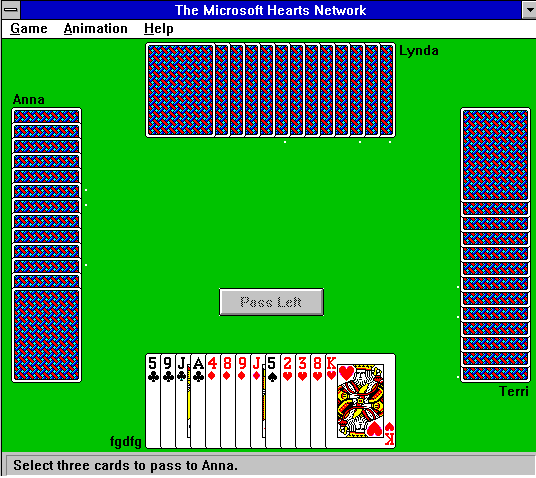
Many players remember facing named computer opponents rather than anonymous seats. The version represented on HeartsExe.com shows Anna, Lynda and Terri. Names and interfaces could differ between releases, and Microsoft documentation explains that computer-player names could also be changed through configuration.
What Made Windows Hearts Memorable?
Part of the appeal was its simplicity: a green table, four hands of cards, and familiar Windows window borders. Yet the game had real strategic depth. The Queen of Spades could change a round in a moment, and shooting the moon offered an unforgettable gamble.
Hearts Today
Modern browser versions preserve the core decisions of following suit, choosing when to dump penalty cards, and keeping score low. HeartsExe.com is a nostalgic browser tribute to that era rather than an official Microsoft release.
Read the Hearts gameplay and scoring guide →
Historical References
- Microsoft, Windows for Workgroups 3.1 Resource Kit (1992) — Hearts network play and customizable computer player names.
- Microsoft Knowledge Base Q126746 (archived) — Windows for Workgroups version history.